Most organisations are in a constant state of change.
Strategies are developed. New solutions are introduced. Structures are adjusted.
And yet, the results often fall short – or take far longer to materialise than expected.
In our experience, this is rarely about the quality of the decisions themselves.
It is about what happens next – how those decisions are translated into action, and how change is actually carried forward in the organisation.
Change happens in everyday work
Most of the literature on this topic points in the same direction:
Change is not the decision – it is what people do afterward.
Kotter emphasises the importance of clear direction and sustained reinforcement.
The ADKAR model highlights understanding, motivation and capability.
Research on motivation, particularly Self-Determination Theory (Deci & Ryan), shows that people take ownership when they experience meaning, mastery, and a sense of autonomy.
Change does not happen because people are informed. It happens when they are able to understand and apply what is expected of them in situations that reflect their actual work.
That is when behaviour begins to shift – in the choices people make, in how they prioritise, and in how they interact with others.
When direction does not translate into action
In practice, a familiar gap often emerges.
Direction is clear. Initiatives are defined. Communication has been delivered. And still – it is unclear what this means in practice, or how it should shape everyday decisions.
The most important questions remain:
What should I do differently now? Which choices actually matter? What does this mean for me and what is expected of me in my role?
When these questions are left unanswered, implementation slows or stops altogether. Even in well-designed initiatives.
Understanding is built through dialogue, not just information
The instinctive response is often to communicate more.
But information rarely leads to change on its own. Research on learning shows that understanding is built through active engagement – not passive consumption. And while the idea of fixed “learning styles” has largely been challenged, one thing remains clear: what matters is whether people can connect new insights to situations where they actually need to use them.
That connection is created through dialogue, which this is where real alignment happens.
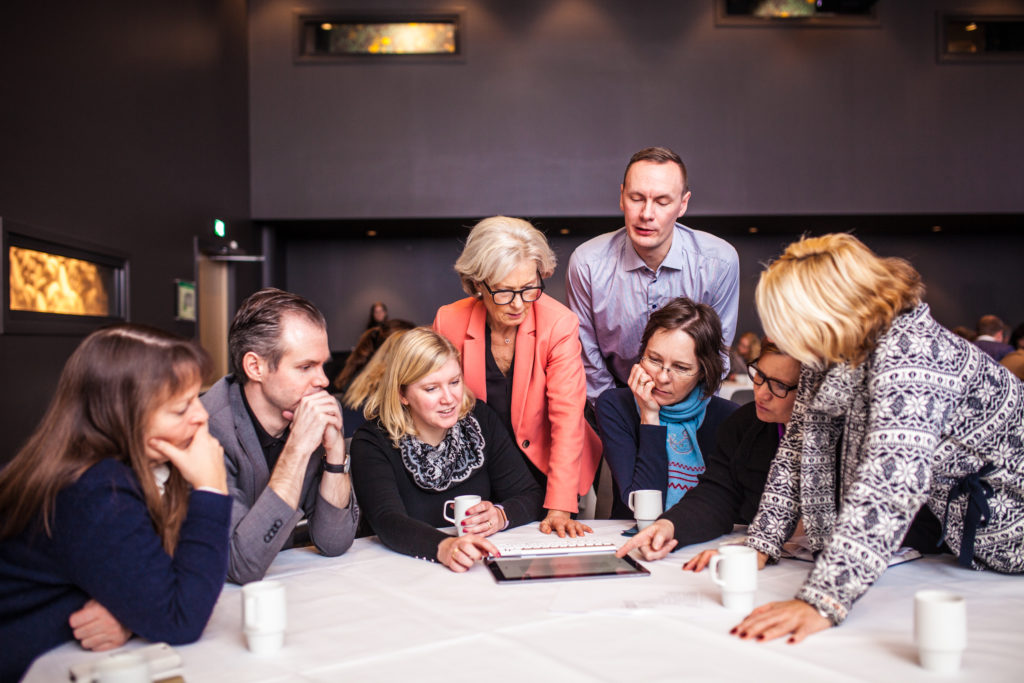
When people are given the space to discuss, challenge, and make things tangible, they develop what we often call action competence: the ability to apply knowledge in real-life situations.
We have supported several organisations in improving safety and reducing incidents, and more often than not, the issue is not lack of procedures. The problem is inconsistency in how they are interpreted and a lack of clarity around how requirements, risk, and individual decisions are connected.
Through structured conversations grounded in real work situations, both leaders and employees develop a clearer understanding of what is expected, and why. That is when behaviour starts to change.
From direction to decisions
Change only becomes manageable when it becomes concrete.
That means linking strategic direction to real decisions, clarifying responsibilities within specific roles, and creating space to reflect on the situations people actually face.
Rather than adding more information, we focus on making existing decisions clearer and more actionable. Using simple, structured formats, we help teams surface and discuss what would otherwise remain abstract and connect it directly to day-to-day work.
This is where implementation, alignment, and operationalisation come together in practice: in the moment people understand what is actually expected of them.
That is where ownership begins.
Why understanding matters more than ever
The need for this kind of work extends beyond organisations.
In a world defined by speed, strong opinions, and quick conclusions, the ability to pause, explore and add nuance is becoming increasingly important. When complex issues are simplified too quickly, the quality of decision-making suffers.
This applies at every level, both within organisations and across society.
When structure, role and behaviour align
Organisations can redesign structure, introduce new systems, and shift priorities.
But real impact only happens when people understand the bigger picture, recognise their role, and begin to act differently in practice.
When direction, role and behaviour are aligned, something shifts. Not necessarily overnight, but in ways that tend to last.
It is hard work. But it is entirely achievable.